
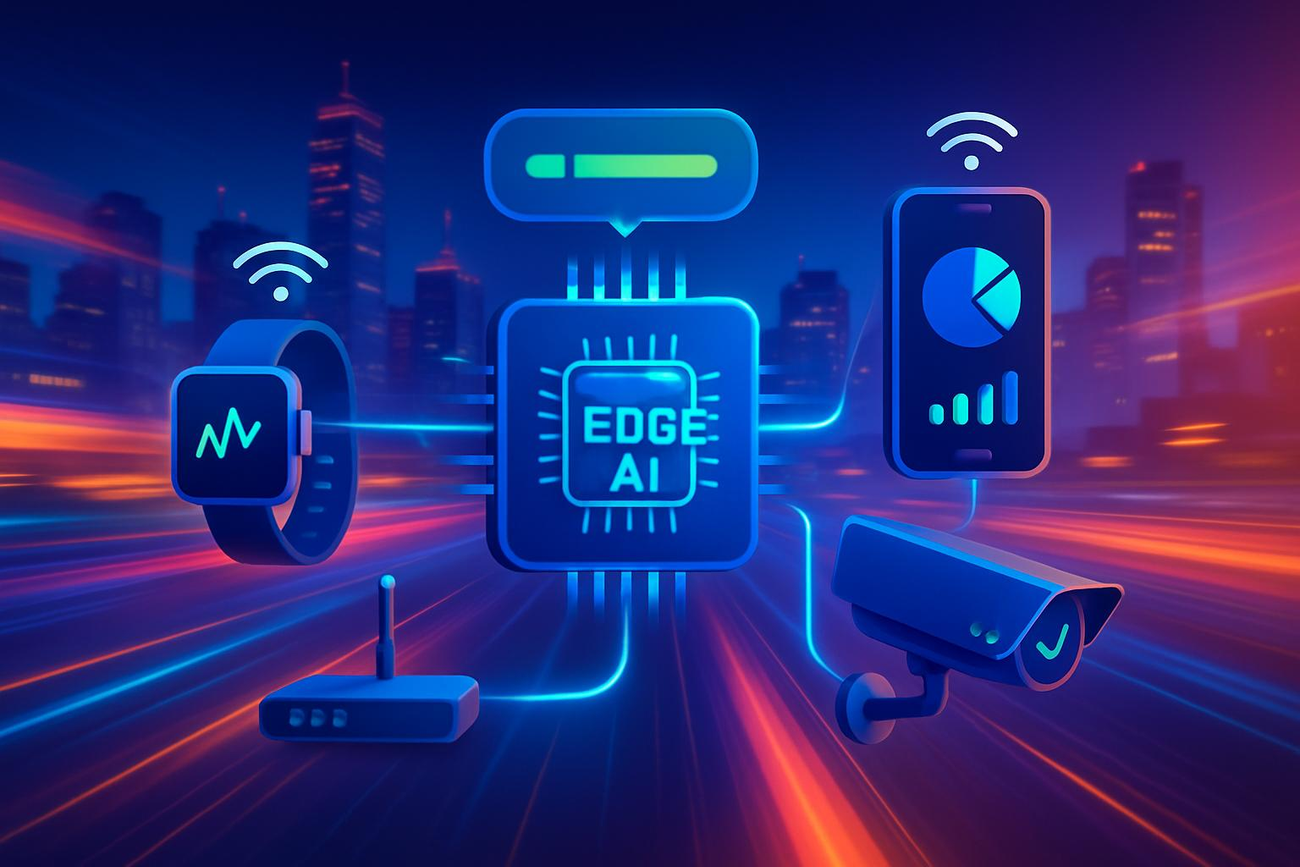
Imagine your smartphone recognizing your voice instantly, your smartwatch detecting unusual activity, or your security camera identifying a visitor without sending every video recording to the cloud.
This is the power of Edge AI.
Artificial intelligence is moving beyond large data centers and becoming part of everyday devices. From smartphones and smart home appliances to wearable technology and connected vehicles, Edge AI is making technology faster, smarter, and more responsive.
But how does it work, and why is it changing the future of smart devices?
Let’s explore.
What Is Edge AI?
Edge AI is a technology that allows artificial intelligence models to process information directly on devices or nearby computing systems instead of relying entirely on remote cloud servers.
For example, a smart security camera can recognize movement locally and send an alert when it detects unusual activity.
This reduces the need to transfer large amounts of data over the internet.
How Does Edge AI Work?
Edge AI combines machine learning, specialized hardware, and local data processing.
The process generally follows five steps:
- Data Collection: A device collects information through cameras, microphones, or sensors.
- Local Processing: The device processes incoming information using an AI model.
- Pattern Recognition: The model identifies objects, sounds, movements, or unusual behavior.
- Decision Making: The device determines an appropriate response.
- Action: It performs an action, such as activating an alert or adjusting a setting.
AI models are often trained using powerful cloud infrastructure before being optimized and deployed on smaller devices.
7 Ways Edge AI Is Changing Smart Devices
1. Smartphones Are Becoming More Intelligent
<AsyncImage query=”Modern smartphone AI on device features camera voice assistant futuristic technology” aspectRatio=”16:9″ width=”100%”/>
Edge AI enables smartphones to perform intelligent tasks directly on the device.
Examples:
- Real-time photo enhancement.
- Voice recognition.
- Offline language processing.
- Smart keyboard suggestions.
- Background noise reduction.
This makes everyday smartphone experiences faster and more personalized.
2. Smartwatches Are Improving Health Monitoring
<AsyncImage query=”Smartwatch wearable technology health monitoring fitness AI interface” aspectRatio=”16:9″ width=”100%”/>
Wearable devices can use AI to analyze activity patterns and sensor information.
Examples:
- Activity recognition.
- Sleep pattern analysis.
- Heart-rate pattern monitoring.
- Fitness recommendations.
- Potential irregularity alerts.
These features can support personal wellness monitoring but should not replace professional medical diagnosis.
3. Smart Homes Are Becoming More Responsive
<AsyncImage query=”Modern smart home AI thermostat lights security connected home devices” aspectRatio=”16:9″ width=”100%”/>
Edge AI allows smart home devices to respond more intelligently to their surroundings.
Examples:
- Smart thermostats adjusting temperatures.
- Intelligent lighting systems.
- Voice-controlled appliances.
- Local security alerts.
- Automated energy management.
4. Security Cameras Are Getting Smarter
<AsyncImage query=”AI smart security camera detecting person home surveillance technology” aspectRatio=”16:9″ width=”100%”/>
Traditional cameras record footage, but AI-powered cameras can analyze what they capture.
Examples:
- Human and vehicle detection.
- Unusual movement recognition.
- Package detection.
- Local event notifications.
- Reduced unnecessary alerts.
5. Smart Cars Are Becoming Safer
<AsyncImage query=”Modern smart electric vehicle dashboard AI computer vision driver assistance” aspectRatio=”16:9″ width=”100%”/>
Vehicles use AI-powered systems to interpret information from cameras, radar, and other sensors.
Examples:
- Lane detection.
- Driver monitoring.
- Obstacle recognition.
- Parking assistance.
- Traffic sign recognition.
Local processing is particularly important when vehicles need to react quickly to changing road conditions.
6. Smart Appliances Are Learning Daily Habits
<AsyncImage query=”Modern smart refrigerator washing machine intelligent home appliance technology” aspectRatio=”16:9″ width=”100%”/>
Edge AI is helping connected appliances become more efficient and responsive.
Examples:
- Smart refrigerators monitoring stored items.
- Washing machines optimizing cycles.
- Intelligent energy management.
- Predictive maintenance alerts.
7. Industrial Devices Are Becoming Predictive
<AsyncImage query=”Smart industrial factory machinery sensors edge AI predictive maintenance dashboard” aspectRatio=”16:9″ width=”100%”/>
Factories use Edge AI to analyze information from machines and sensors.
Examples:
- Detecting unusual vibrations.
- Identifying manufacturing defects.
- Predicting equipment failures.
- Monitoring production quality.
- Improving workplace safety.
Edge AI vs Cloud AI: What’s the Difference?
| Feature | Edge AI | Cloud AI |
|---|---|---|
| Processing | Local device or nearby system | Remote cloud servers |
| Response | Often faster for local tasks | Depends on network connection |
| Internet | Can work offline for supported tasks | Usually requires connectivity |
| Privacy | Can keep data locally | Data may need to be transmitted |
| Computing Power | Limited by device hardware | Access to powerful infrastructure |
| 最適な用途 | Real-time device intelligence | Complex large-scale processing |
Both technologies complement each other. Smart devices can handle immediate decisions locally while using cloud services for complex analysis and model updates.
Benefits of Edge AI for Smart Devices
- Faster responses: Reduces communication delays.
- Improved privacy: Sensitive information can remain on the device.
- Offline functionality: Some AI features continue working without internet access.
- Lower bandwidth usage: Less raw information needs to be transmitted.
- Greater reliability: Devices can perform supported tasks during connectivity problems.
- Efficient automation: Local intelligence enables faster actions.
Challenges of Edge AI
Despite its advantages, Edge AI has some limitations:
- Limited processing power and memory.
- Battery and energy consumption.
- Device security vulnerabilities.
- Difficulties updating models across many devices.
- Smaller models may be less capable on complex tasks.
Developers must balance model accuracy, hardware requirements, energy efficiency, and privacy.
What Is the Future of Edge AI?
Edge AI is expected to become increasingly important as smart devices become more powerful.
Future developments may include smarter personal assistants, more capable wearable devices, intelligent robotics, advanced vehicle systems, and more private on-device AI experiences.
The combination of Edge AI and cloud computing will likely create a powerful technology ecosystem where devices handle immediate decisions while cloud systems manage demanding tasks.
まとめ
Edge AI is changing smart devices by bringing artificial intelligence closer to users. Smartphones, smartwatches, security cameras, vehicles, and home appliances are becoming more capable of understanding information and responding independently.
Its biggest advantage is simple: intelligence can operate where the action happens.
For more AI technology guides, tutorials, and useful artificial intelligence tools, visit FoocusAI.
The future of smart technology isn’t just connected devices. It’s devices that can think, respond, and act intelligently!
